
Celebrate Scars as History. Craft Your One-of-a-Kind Vintage.
In our main article, we explored how the world’s highest-end fashion houses have been captivated by the historical value of traditional Japanese “Boro” (patchwork) and “Sashiko” (stitching), redefining worn-out fabrics as the ultimate luxury. Instead of discarding mass-produced clothes after a few wears, a global movement of “Visible Mending” has emerged. By beautifully repairing tears and frays with your own hands, you weave a unique narrative into the fabric—a practice now championed as the coolest and most environmentally friendly form of self-expression.
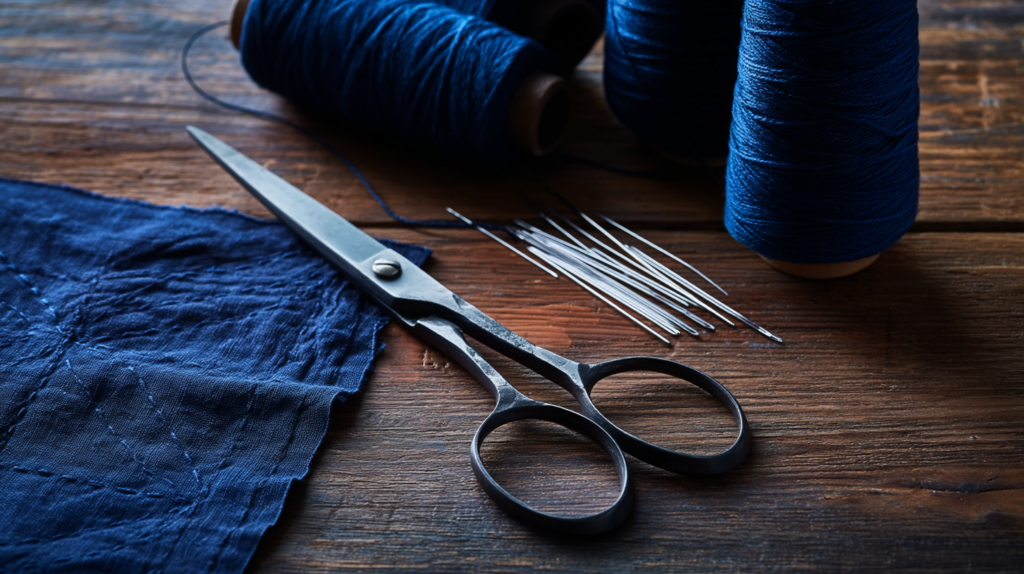
To embrace this deep reverence for objects and elevate your favorite denim or jacket into a lifelong companion, you need “authentic tools” that fundamentally change the precision of your craft. Here, we introduce three pinnacle Japanese sewing tools—revered by professional creators worldwide—that embody centuries of traditional craftsmanship.
1. Astonishing Sharpness and Durability: “Shozaburo” Tailor’s Shears
When accurately cutting thick denim or multiple layers of Boro fabric, the quality of your scissors is the most critical factor in reducing work stress. “Shozaburo,” Japan’s world-renowned premier brand of tailoring shears, crafts each pair meticulously by hand, inheriting the legendary metallurgy1 and forging2 techniques used to create Japanese katana swords.
Forged from premium cutlery steel, the blades grip the fabric securely and glide through effortlessly with minimal pressure. This exceptional sharpness and durability have earned them a reputation among international tailors and denim enthusiasts as a “lifelong masterpiece.” Combining aesthetic beauty with peerless functionality, simply holding them ignites a deep desire to create.
2. A Different Dimension of Smoothness: Kyoto’s “Misuya” Needles for Sashiko
Because Sashiko involves pushing a needle repeatedly through thick, layered fabrics, the smoothness of the needle directly affects both the beauty of the finish and hand fatigue. For this, “Misuya Needles,” a beloved institution in Kyoto for generations, is the ultimate recommendation.
The defining characteristic of a Misuya needle is the specialized artisan technique of “vertical polishing” applied to its surface. This drastically reduces friction with the fabric, allowing the needle to pass through surprisingly smoothly even in dense textiles. Furthermore, they perfectly balance hardness with flexibility, making them highly resistant to breaking during long hours of work and significantly reducing the strain on your fingers. Often praised by artisans who say, “Once you use them, you can never go back to other needles,” they are small works of art infused with the craftsman’s soul.
3. The Deep Blue That Paints the Passage of Time: Natural Indigo-Dyed Sashiko Thread
The element that defines the beautiful worldview of “Boro-Chic” is the presence of the thread against the fabric. When pursuing true authenticity in the repair and decoration of clothing, selecting Sashiko thread dyed with “natural indigo” rather than chemical dyes is the absolute best choice.
High-quality threads dyed using genuine Awa Indigo from Tokushima Prefecture boast a profound, mesmerizing blue. As the garment is washed repeatedly and exposed to sunlight alongside you, the thread itself gradually fades. This allows you to fully enjoy the aging (patina) 3process, as the stitches seamlessly integrate with the fabric like vintage denim. Savor the process as the stitches you carefully sew evolve into your own personal art over time.
Conclusion: The Sustainability of Loving Scars
Instead of throwing away a torn garment, mend it with your own hands and bring it back to beautiful life. What Japanese “Boro” and “Sashiko” teach us is the perspective that scars and wear are not defects to be hidden; rather, they are proof of the time the object has endured, and the very source of its beauty.
Acquiring the finest tools and spending a quiet weekend evening slowly passing a needle and thread through fabric, stitch by stitch… This time will not only extend the life of your clothing but will also serve as a rich, meditative moment to step away from a busy modern life and center your own mind.
References
- metallurgy:
The technology concerned with the extraction, refining, and processing of metals to create materials with desired properties, which forms the foundation of Japanese blade making.↩︎ - forging:
A metalworking process where compressive forces are applied to metal to close internal voids and align the crystalline structure, greatly increasing its strength.↩︎ - aging (patina):
The gradual change in the color and texture of a material over time. Highly valued in leather goods, denim, and natural dyes as a unique character that deepens with use.↩︎
Disclaimer The information regarding products and practices in this article is provided for educational and informational purposes only. Experiences and aging effects may vary from person to person. This article does not contain affiliate links, and the publisher assumes no responsibility for any purchases or transactions made outside of this website.
– The World Seen by a Japanese and AI –